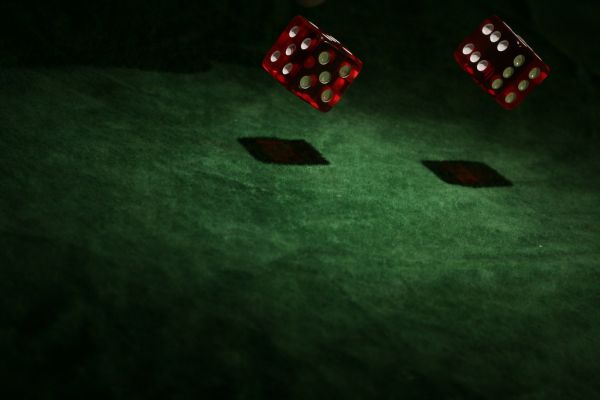
Craps can look chaotic to a newcomer, with a crowded table, a shooter rolling dice, and players calling out bets. Underneath the noise, though, the core of the game follows a fairly simple two-stage structure built around a pair of six-sided dice.
The come-out roll
A round begins with the shooter's come-out roll. If the dice show a 7 or 11, pass line bets win immediately. If they show 2, 3 or 12, pass line bets lose immediately; this is called craps, which gives the game its name. Any other total, 4, 5, 6, 8, 9 or 10, becomes the point for that round.
Establishing and chasing the point
Once a point is set, the shooter keeps rolling until one of two things happens: the point number comes up again, which wins the pass line bet, or a 7 appears first, which loses it. Players can also add odds bets once a point is established; these pay at true odds with no additional house edge of their own, though they only exist alongside a bet that does carry one. Craps tables also carry a long list of side bets, often called proposition bets, that can be placed on almost any single roll, and these are generally announced loudly by the stickman running the game.
- Come-out roll: 7 or 11 wins, 2/3/12 loses, anything else sets the point
- Shooter rolls repeatedly until the point or a 7 appears
- Point repeats before a 7: pass line wins
- 7 appears before the point repeats: pass line loses
Where the edge sits
The basic pass line bet carries a house edge of a little under one and a half percent, one of the lower edges on a casino floor, while many of the proposition bets scattered around the table carry much higher edges. No combination of bets changes the fact that, over enough rolls, the built-in probabilities favour the house, since the number of ways to roll a 7 with two dice is simply greater than the number of ways to roll any other total. Treat craps as a fast, social game for small stakes and a fixed budget, not a source of income, and use its pace as a reason to set a time limit as well as a spending one.


