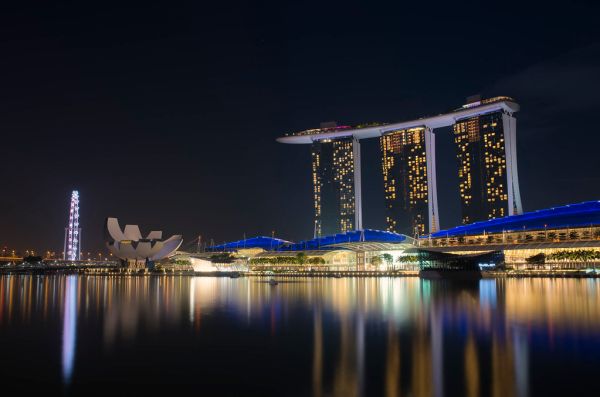
Marina Bay Sands has dominated the Singapore skyline since it opened in 2010, and it remains one of the most photographed buildings in the world. Designed by architect Moshe Safdie, the resort consists of three 55-storey towers connected at the top by a vast sky-bridge known as the SkyPark, which holds an infinity pool overlooking the city and the strait beyond. The scale of the project made it one of the most expensive standalone integrated resorts built anywhere at the time of its construction.
An engineering statement
The three leaning towers were an unusual structural challenge. Each tower tilts outward before the SkyPark ties them together, meaning engineers had to solve problems that had rarely, if ever, been attempted at this height. The result is a building that functions as both hotel and landmark, visible from much of the surrounding bay and reproduced endlessly in tourism photography of Singapore.
What the resort contains
Beyond the hotel rooms, Marina Bay Sands houses a large convention centre, a shopping mall with a canal running through it, and the ArtScience Museum, whose lotus-shaped building sits at the water's edge. The casino floor itself is one of the larger gaming areas in Asia, offering the usual mix of table games and slot machines found in major international resorts. As with any casino anywhere in the world, the games on offer are built around a mathematical house edge, meaning the operator is structured to profit over time regardless of any individual result.
A resort built for more than gambling
What sets Marina Bay Sands apart from many older casino resorts is how much of its identity rests outside the gaming floor. The SkyPark, the museum, the shopping and dining, and the events held in its convention spaces are all designed to draw visitors who may never place a bet. This mirrors a broader shift in destination casino resorts, where architecture, entertainment and hospitality increasingly carry as much weight as the gaming itself.
For anyone who does visit the casino floor, it is worth remembering that these games are designed as entertainment with built-in odds favouring the house, not a way to generate income. Treating a visit as a paid experience, similar to a show or a meal, rather than an investment, keeps expectations realistic.


